
On Being Human in a Digital Age
Bill Buxton's closing keynote at CHI 2008, Florence

Update 2025: Finally, a yet unknown recording of Bill Buxton’s closing keynote at CHI 2008 has been published. This is wonderful because I consider it the best CHI keynote ever. At least it had a huge impact on my thinking since then.
Reconstructed Slides
Some Notes
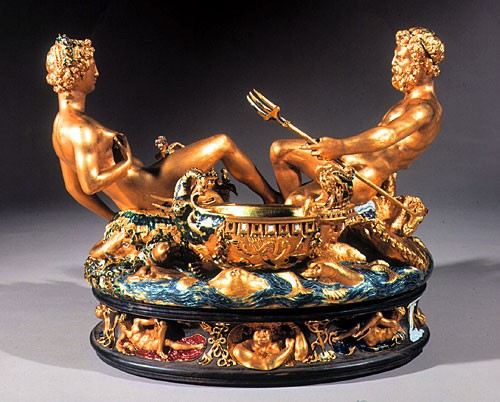
Saliera (Salt Cellar) by Benvenuto Cellini, ca. 1541
Cellini was a master goldsmith. But he aimed for something higher. For years tried to be as good as Michaelangelo.
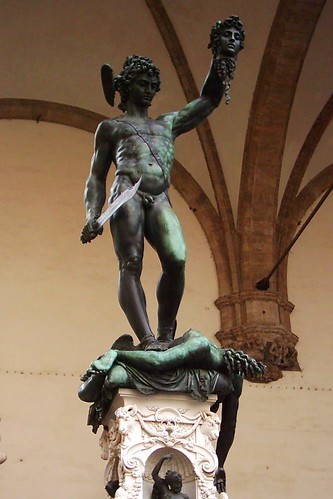
Perseus with Head of Medusa by Benvenuto Cellini, 1545-54

Even a talent as great as Mozart’s did not emerge from a vacuum. He was a product of a culture that had evolved to reflect a particular set of values, with or without him. He needed a great teacher (his father), new instruments (fortepiano), and also concert halls to perform his art. What if Leopold Didn’t Have a Piano?

"In the ealrly 70s I had a copy-cat of Engelbart's mouse – and full hair then."

State-of-the-art of the science vs. State-of-the-science of the art
Problem solving vs. Problem setting
Technology is not good,
technology is not bad,
but nor is it neutral.
Invention is the mother of necessity.
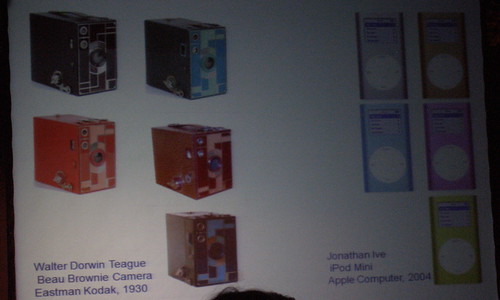
Walter Dorwin Teague, Beau Brownie Camera, Eastman Kodak, 1930
Jonathan Ive, iPod Mini, Apple Computer, 2004

Jonathan Ive, iPhone, Apple Computer, 2007
Simon SmartPhone, IBM & Bell South, 1993
Newton Message Pad, Apple Computer, 1993 – 1998 (not shown)

"I am complaining on the level of informed discussions. Write more papers and articles!"
The level of discourse about technology, and human-computer interfaces in particular, is awful. He contrasted two articles he and he wife were reading on a plane recently: hers was a review of an art exhibit, his a review of the $100 laptop (OLPC). Hers was deeply written and considered the exhibit within social, historical, and philosophical contexts -- something that's just naturally a part of art criticism; his talked about technical specs and barely considered the human context of the device. We don't have a well-developed practice of "interaction criticism" (a theme that popped up elsewhere at CHI too). HCI professionals should take time out to write for a public audience. (from questiontechnology.org)

"societies doe not evolve because their members simply grow old, but rather because their mutual relations are transformed." – Ilya Prigogine
… the explorer is actually one who "seeks discoveries," He is not simply and solely the "discoverer." Instead the accent is upon the process and activity, with advances in knowledge simply fortunate through expected incidents along the way. It is likewise not casual. It is purposeful.
– Goetzmann (1966), p. xi
Can cultures change? Yes, if you consider that you are not permitted smoking in Italy anymore, and that you are ought to clean up your pet's poo.

"Let My People Go Surfing: The Education of a Reluctant Businessman" (Yvon Chouinard)
Other Pages
- Bill Buxton's Bad Ass CHI 2008 Keynote by Nate Bolt
Bill Buxton's CHI 2008 Closing Keynoteat questiontechnology.orgBill Buxton: the CHI community’s Renaissance Scientistby Joanna BawaBill Buxton on Innovation and the Long Nose Theoryby Konigi
- The Long Nose of Innovation, Bill Buxton 2008
- What if Leopold Didn’t Have a Piano? Bill Buxton 2006
- Social planning and communities the information highway, Bill Buxton 1994
- Design Thinking in the Wild, IDSC08
- Bill Buxton's keynote at mix09 (20')
 NUI – What’s in a name, DxF 2010 (66') /lost video
Bill Buxton on technology as cultural artifact,channel9, 2010- Bill Buxton | Socializing technology for the mobile human, TNWConf Europe 2016
“Wild Design for Living in the Wild” Bill Buxton – Interaction19